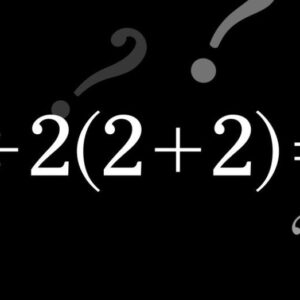
At first glance, this problem looks simple:
6 ÷ 2(1 + 2)
But this exact equation has caused massive debate online — because depending on how you interpret it, you might get two completely different answers.
Some people immediately say 1.
Others confidently argue it’s 9.
So what’s actually going on?
The confusion comes from how people apply the order of operations — specifically how they treat the parentheses and multiplication.
Let’s break it down step by step:
First, solve what’s inside the parentheses:
1 + 2 = 3
Now the equation becomes:
6 ÷ 2 × 3
From here, many people make the mistake of grouping 2(3) together as if it must be solved first.
But according to standard order of operations (PEMDAS/BODMAS):
- Multiplication and division are handled left to right, not based on grouping unless explicitly shown.
So now we go left to right:
6 ÷ 2 = 3
3 × 3 = 9
✔️ Final Answer: 9