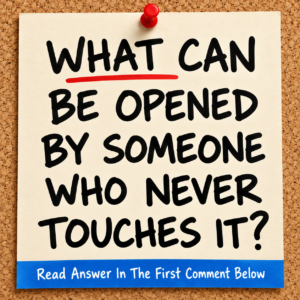
Here is a short question that sounds easy until you start thinking about it: What can be opened but never closed?
A door can be opened, but it can also be shut. The same goes for a window, a box, a book, and a cabinet. So the answer has to be something that changes once it is opened and cannot simply be returned to its original state.
Think about what opening means
We use the word open in many different ways. We open a letter, a package, a jar, a store, and even a conversation. Some of these can be closed again, while others cannot be put back exactly as they were.
For this riddle, consider an object that is opened by breaking its outer shell. Once that shell is broken, closing it again in the original way is not really possible.
The riddle answer
Answer: An egg.
You can crack open an egg, but once its shell has been broken apart, you cannot simply close the egg again as though nothing happened. You might place pieces together or put the contents in another container, but that is not the same as restoring an intact egg.
Why the egg makes sense
The riddle depends on our first instinct to imagine an object with a lid, door, or hinge. Such things are designed to open and close repeatedly. An egg, by contrast, can be opened only by breaking its shell. That one-way action is the clever part of the answer.
Other playful answers are sometimes offered for this kind of word riddle, but an egg is a straightforward solution that fits the ordinary meaning of both words.
Try this one on family and friends
Ask someone the question without any clues. If they start naming doors, windows, and boxes, remind them to think of something that cannot be returned to its original condition after opening.
For a gentler hint, try: You might find it in the kitchen. For a stronger one, say: It has a shell. See whether the answer makes them laugh when they finally think of an egg.
Short riddles like this are memorable because they turn something ordinary into a small mental challenge. Sometimes the most obvious answer only becomes obvious after you have heard it.