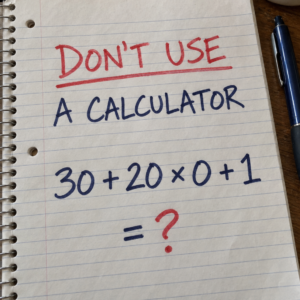
This looks like one of those questions you can answer instantly: 1 + 2 × 3 − 4. Most people don’t even pause—they just go straight through it from left to right. But that’s exactly where the mistake happens.
The brain naturally wants to go in order: 1 + 2 = 3, then 3 × 3 = 9, then 9 − 4 = 5. It feels smooth, fast, and convincing… but it’s wrong.
The key to solving this correctly is remembering a simple rule from basic math: multiplication comes before addition and subtraction. So instead of rushing, you start with 2 × 3, which equals 6. Then you continue: 1 + 6 = 7, and finally 7 − 4 = 3.
What makes this puzzle interesting isn’t the difficulty—it’s how easily people ignore the rules when something looks simple. The easier it appears, the more likely people are to rely on instinct instead of logic.
That’s why so many get different answers. Not because the math is hard, but because attention slips for just a second.
So the real question is… did you follow the rules, or did your brain try to take a shortcut?