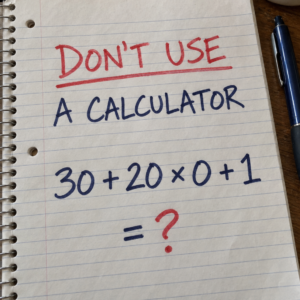
This equation is a classic order-of-operations trap. Because addition and division appear together, the division must be handled before the additions. If you simply work from left to right, you will end up with the wrong result.
Begin with 6 ÷ 6, which equals 1. The expression then becomes 6 + 1 + 6. Add those numbers together and the final result is 13. So the correct answer is 13.
The reason this puzzle causes so much debate is that the numbers are simple enough to tempt people into rushing. But the standard order of operations still applies even when every number is the same.
If you got 13 without using a calculator, you applied the rule correctly. These small equations are a quick way to test whether you are paying attention to the operation signs.