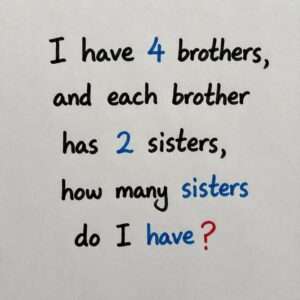
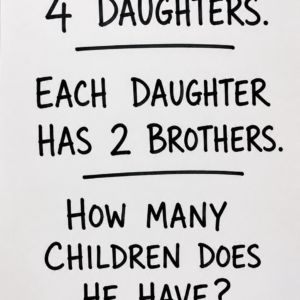
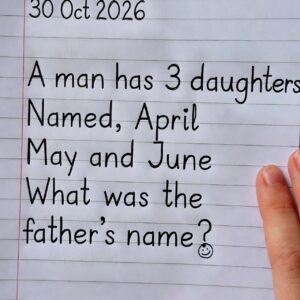
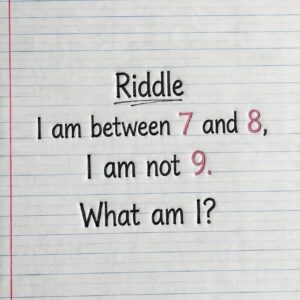
Here is a quick riddle that seems easier than it really is: “I have 2 brothers, and each brother has 2 brothers. How many are we?” At first glance, you might start adding the brothers mentioned in each part of the sentence. But that is exactly where the trap lies.
What is the correct answer?
The answer is 3 brothers in total. The person speaking has two brothers. That gives us three siblings: the speaker, Brother A, and Brother B.
Why does each brother also have two brothers?
Think about each person in the same family. The speaker counts Brother A and Brother B as his two brothers. Brother A counts the speaker and Brother B. Brother B counts the speaker and Brother A. Everyone has exactly two brothers, even though there are only three boys altogether.
The trick is that the brothers are the same people being counted from different points of view. The sentence does not describe new or separate sets of brothers.
Why this little riddle works
Our minds sometimes treat every number in a puzzle as something to add. In this case, the important clue is the word “each.” It asks you to change perspective, not increase the size of the family.
Try it with three friends sitting around a table. Each person has two other friends at the table. You still have three people, not seven.
Final answer: 3 brothers. Did you solve it immediately, or did you count the same brothers more than once? Share it with someone who enjoys short logic puzzles.