This Simple Math Problem Is Dividing the Internet — Is the Answer 1 or 9?

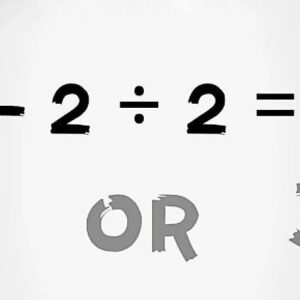
At first glance, this problem looks simple:

6 ÷ 2(1 + 2)

But this exact equation has caused massive debate online — because depending on how you interpret it, you might get two completely different answers.

Some people immediately say 1.

Others confidently argue it’s 9.

So what’s actually going on?

The confusion comes from how people apply the order of operations — specifically how they treat the parentheses and multiplication.

Let’s break it down step by step:

First, solve what’s inside the parentheses:

1 + 2 = 3

Now the equation becomes:

6 ÷ 2 × 3

From here, many people make the mistake of grouping 2(3) together as if it must be solved first.

But according to standard order of operations (PEMDAS/BODMAS):

  • Multiplication and division are handled left to right, not based on grouping unless explicitly shown.

So now we go left to right:

6 ÷ 2 = 3

3 × 3 = 9

✔️ Final Answer: 9
Related Posts

What Has a Beginning but No End? Classic Riddle Answer

This riddle asks: What has a beginning but no end? A useful way to solve it is to think about geometry rather than everyday objects. The answer…

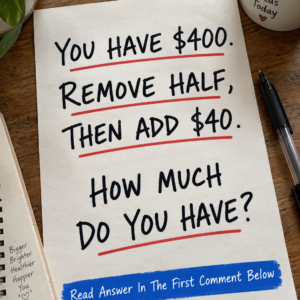
You Have $400, Remove Half, Then Add $40 — How Much Do You Have?

This puzzle starts with $400 and gives two instructions: remove half, then add $40. The key is to apply each step in order. The answer is $240….

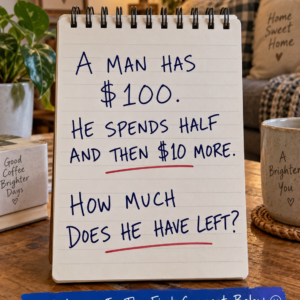
A Man Has $100, Spends Half and Then $10 More — How Much Is Left?

This money puzzle says: a man has $100. He spends half of it and then spends another $10. How much money does he have left? The answer…

What Can You Hear Once but Never Hear Again? Riddle Answer

This riddle asks: What can you hear once, but never hear again? The trick is to think about a single sound as a unique moment in time….

What Can Go Around the World Without Ever Leaving Its Corner?

This famous riddle asks: What can go around the world without ever leaving its corner? The wording sounds like it must describe something that travels, but the…

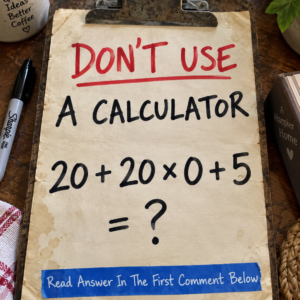
20 + 20 × 0 + 5: Can You Solve It Without a Calculator?

This quick math puzzle asks you to solve 20 + 20 × 0 + 5. The numbers are simple, but the order of operations is what matters….