If you’re like many people, the days of sitting in a classroom solving endless math problems can feel like a distant memory. But thanks to the internet, math is back in a new form — short brain teasers that look easy, spark arguments, and get shared everywhere.
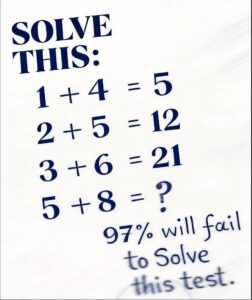
One puzzle that keeps resurfacing is this sequence:
1 + 4 = 5
2 + 5 = 12
3 + 6 = 21
5 + 8 = ?
At first glance, it looks like basic addition. Then you try it… and it makes no sense. That’s the trick: the “+” sign isn’t being used in a normal way. The puzzle is a pattern problem, meaning you have to find the hidden rule.
The most common intended rule is cumulative:
-
Start with the first line: 1 + 4 = 5
-
For the second line, add the new numbers to the previous result: 5 + (2 + 5) = 12
-
For the third line, add the new numbers to the previous result: 12 + (3 + 6) = 21
-
For the final line, do the same: 21 + (5 + 8) = 34
So the answer is:
5 + 8 = 34
This is why the puzzle gets people: once you see the pattern, it feels obvious — but until then, your brain keeps trying to force “normal” arithmetic onto something that isn’t normal at all.