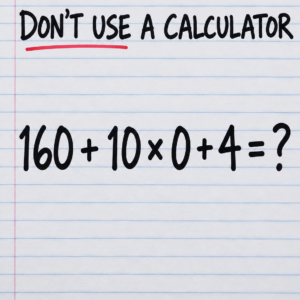
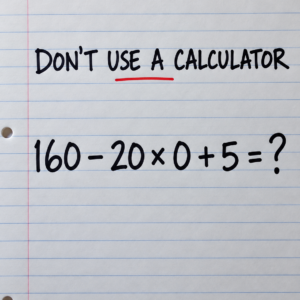
A short arithmetic question can sometimes cause a surprisingly long argument. Try this one: 160 − 30 × 0 + 8 = ? The challenge asks you to work it out without a calculator. It only takes two steps if you follow the correct rules.
What is the correct answer?
The answer is 168. Here’s why.
Step-by-step explanation
Multiplication is performed before addition or subtraction. Begin with 30 × 0 = 0.
Now replace that part of the expression with zero: 160 − 0 + 8. Subtract zero from 160, then add eight. The result is 168.
Why can people get it wrong?
The most common mistake is subtracting 30 from 160 first, simply because subtraction appears earlier in the expression. But the mathematical order of operations tells us to multiply first. Another mistake is assuming that multiplying by zero makes the entire equation zero: it only makes the product 30 × 0 equal zero.
Once you know the rule, it’s an easy mental-math challenge. Did you get 168 on your first attempt? Try asking a friend before showing the explanation.