Here’s a familiar riddle that tests whether you can think beyond the obvious meaning of everyday words:
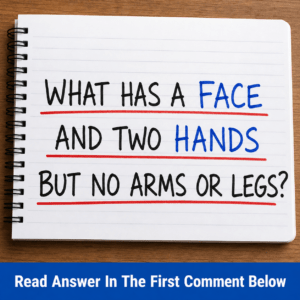
What has a face and two hands but no arms or legs?
A person needs arms to have hands, right? Not necessarily in a riddle. The trick is to think about objects whose parts have the same names.
The answer
A clock!
A traditional clock has a face and two main hands—the hour hand and the minute hand—but no arms or legs.
Once you hear the answer, the clue seems obvious. That’s why simple classic riddles remain so popular: they invite us to look at familiar things in a slightly different way.
Did you guess a clock before reading the answer? Try it on a friend and see what they say.