A good riddle can make an ordinary word seem mysterious. Here is a favorite that sounds strange until you realize it has more than one possible meaning:
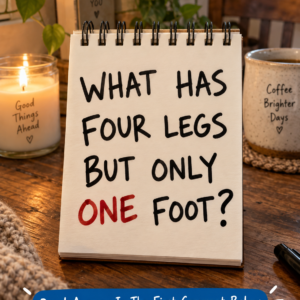
What has a foot but no legs?
The first thing most people picture is a person or an animal. But a foot is not always part of a body. It can also describe a unit of measurement or the lower part of an object. The riddle asks you to think about language rather than anatomy.
Think about what a foot can mean
Consider the everyday tools you might find in a drawer, at a school desk or in a workshop. Some are used for measuring length, and one common unit of length is called a foot. That should point you toward an answer without giving it away immediately.
If you are still thinking of shoes or feet with toes, remember that the question specifically says there are no legs. That is the clue that the meaning of the word has changed.
The answer: A ruler
A ruler can have a foot without having any legs. A twelve-inch ruler measures one foot in length because 12 inches equal 1 foot. It has that measurement, not a biological foot or legs.
Other answers can work in a broader sense, such as a bed with a foot end, but a twelve-inch ruler is a neat and familiar answer to this version of the riddle.
Why wordplay riddles are memorable
Riddles like this rely on words that carry different meanings. We hear “foot” and immediately think about walking, when the solution asks us to think about measurement. Once the new meaning clicks, the answer is wonderfully simple.
Did you guess a ruler before reading the solution? Share the question with a friend and see which meaning of “foot” comes to their mind first.