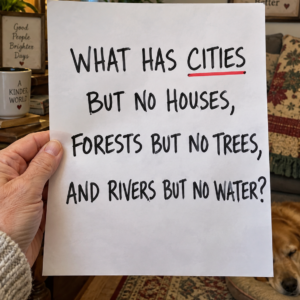
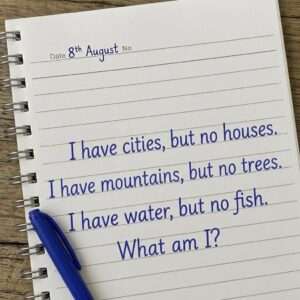
Here’s a classic riddle that sounds impossible: What has cities but no houses, forests but no trees, and rivers but no water?
The answer is a map
A map represents cities, forests, and rivers using printed labels, lines, shapes, and colors. But the map itself contains no real buildings, growing trees, or flowing water.
Why the riddle is tricky
The question encourages us to picture actual landscapes. Cities contain homes and other buildings; forests are full of trees; rivers contain water. But all those features can also be displayed symbolically on a map.
A map is a representation of a place, not the place itself. That distinction makes all three clues fit at once.
Try it on someone else
Read the whole question aloud and ask for a single answer that explains every part. The best riddles often lead us to think too literally before we notice an alternative meaning.
Did you guess “a map” as soon as you heard the question?