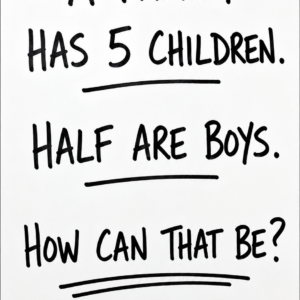
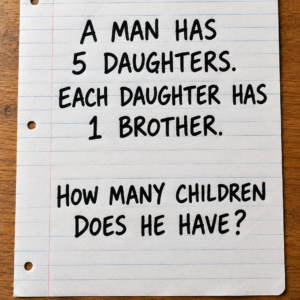
This riddle says: A man has 7 children. They are all boys except 3. How many boys does he have?
The phrase “all boys except 3” is the key. It means three of the seven children are not boys. Therefore, the remaining children are boys.
The answer is 4 boys.
Subtract the three children who are not boys from the seven children in total: 7 − 3 = 4.
People sometimes overthink this type of puzzle because the wording sounds more complicated than the arithmetic really is. There is no hidden extra child and no special calculation. The statement directly tells us that exactly three children are exceptions to being boys, leaving four boys.